Calibration Study 1: Adjusted Claims Conversion Weight
Family: Cal-num, first in order, before Calibration 2 and Calibration 3.
Adjusted Claims, the layer · Adjusted Claims %, the ratio · MABE, the per-share output · conversion weight, the section 3.1 parameter under test
Study date: 2026-07-28. Data as of: 2026-03-31 for disclosed marks, 2026-05-19 for the traded print.
Provenance re-verified: 2026-08-05.
Outcome: the pre-stated tolerance was not met. Computed conversion-weighted outputs remain unlaunched.
Specification v1 section 8 holds the continuous conversion weight behind a calibration gate. No computed conversion-weighted figure appears on any tracker surface until a calibration demonstrates, in public, that traded convertible instruments price within stated tolerance of the model's implied values, with the tolerance stated before results. This document is that calibration.
1. The tolerance, as stated before results
Stated and ratified by Bobby Tierney on 2026-07-28, before any candidate had been scored against any observed mark. Verbatim:
The version transmitted to this lane restated the third clause as absolute error on the repurchase evidence and appended the held-out binding from rulings R3 and R4; at a single print MAE reduces to absolute error, and the held-out binding governs per the ruling log. Substance identical, both forms preserved in the record.
The three magnitudes are stated conventions. They are not derived from the data and no attempt was made to derive them from it. Their function is to be fixed before results exist.
Held-out error is leave one date out. Each of the nine measurement dates is withheld in turn, the fitted candidates are refit on the remaining eight, and the withheld date is scored against that refit. Candidates carrying no free parameters are scored directly.
Provenance, verified. The tolerance was stated and ratified in the governing thread on 2026-07-28, blind, before any fit output existed in any lane. The joint error floor of section 3.4 was computed and disclosed afterward; this lane's own record shows the floor cited in the same message that asked for the not-yet-arrived tolerance. The sequence was adjudicated contemporaneously in the authoritative rulings block, and re-verified against the governing thread's transcript on 2026-08-05. The late transmission was a transport failure, not a sequencing failure. The pre-registration log, including two mis-stamped rulings corrected as authoritative text with the originals preserved, publishes as the companion record.
Pre-registered method rulings
All fixed on 2026-07-28 before scoring. The complete pre-registration record, including the two rulings that were stamped twice and the corrections to both, publishes as a ratified companion at cebetracker.io/research/calibration-1/ruling-log/.
| Ref | Ruling |
|---|---|
| Price map | Map A, the ratified spec 3.1 blend. The bond floor plus option decomposition deferred to Calibration 2. |
| Gate test | Section 8's two-sided price test stands as written. A one-sided restatement was offered and declined. |
| Fitted versus prior scoring | Leave one date out, held out only. Information criteria report as context and bind nothing. |
| Prior deference | Absolute tolerance is the only launch gate. A separate beat-the-prior comparison reports and guides Calibration 2 only. |
| Candidate 1 reading | Both N(d1) and N(d2), scored separately. |
| Candidate 3 reading | Spec 3.1 reading only for the price fit. The claims-line reading documented, not fitted. |
| Rotation-suspect rows | Quarantined from the primary panel, dual run as a labelled sensitivity. Filed data is not edited on a hypothesis. |
| Band boundaries | Left closed, right open, matching the published schedule's explicit "at or above 130 percent". |
| Volatility | Source it. Do not fit it. Do not assume a flat value. |
| Disposition on failure | The no-pass clause publishes verbatim with the structural diagnosis, and the continuous layer stays unlaunched. |
2. Method
2.1 Instruments marked
Six Strategy convertible senior note series. Face amounts as of 2026-03-31.
| Series | Conversion price | Outstanding principal at 2026-03-31 | Marks | First mark | Last mark | Moneyness range |
|---|---|---|---|---|---|---|
| 2028 | 183.1871 | 1,010,000,000 | 7 | 2024-09-30 | 2026-03-31 | 0.6813 to 2.2067 |
| 2029 | 672.4045 | 3,000,000,000 | 6 | 2024-12-31 | 2026-03-31 | 0.1856 to 0.6012 |
| 2030A | 149.7679 | 800,000,000 | 9 | 2024-03-31 | 2026-03-31 | 0.8333 to 2.6990 |
| 2030B | 433.4258 | 2,000,000,000 | 4 | 2025-03-31 | 2026-03-31 | 0.2879 to 0.7434 |
| 2031 | 232.7205 | 603,659,000 | 8 | 2024-03-31 | 2026-03-31 | 0.5363 to 1.3845 |
| 2032 | 204.3318 | 800,000,000 | 7 | 2024-06-30 | 2026-03-31 | 0.6108 to 1.5769 |
Principal is stated as of 2026-03-31 and is not constant across the window for every series. The 2031 declined twice through partial conversions that settled in shares: 603,750,000 for the marks from 2024-03-31 through 2025-03-31, then 603,661,000 at 2025-06-30 and 2025-09-30, then 603,659,000 at 2025-12-31 and 2026-03-31. Total decline 91,000 USD, or 0.0151 percent of original face. The other five series held constant principal across their observed marks. Face is carried per mark, not per series, throughout the study and in the exhibit data.
41 disclosed fair-value marks across 9 measurement dates, plus 1 traded mark. Conversion prices are the currently effective post-split figures, each traced to its issuance indenture. Both the stock price and the conversion price are post-split, so moneyness is unaffected by the August 2024 ten for one split.
2.2 Mark dates and price sources
Every fair value is a Level 2 disclosure read from the filing named on its row. No aggregator figures were used.
| Measurement date | Accession | Form |
|---|---|---|
| 2024-03-31 | 0000950170-24-051230 | 10-Q Q1 2024 |
| 2024-06-30 | 0000950170-24-091778 | 10-Q Q2 2024 |
| 2024-09-30 | 0000950170-24-119263 | 10-Q Q3 2024 |
| 2024-12-31 | 0000950170-25-021814 | 10-K FY2024 |
| 2025-03-31 | 0000950170-25-063536 | 10-Q Q1 2025 |
| 2025-06-30 | 0000950170-25-102209 | 10-Q Q2 2025 |
| 2025-09-30 | 0001193125-25-262568 | 10-Q Q3 2025 |
| 2025-12-31 | 0001050446-26-000020 | 10-K FY2025 |
| 2026-03-31 | 0001050446-26-000031 | 10-Q Q1 2026 |
| 2026-05-19 | 0001193125-26-225361 | 8-K, negotiated repurchase |
Stock price is the Nasdaq close on the measurement date, or the last trading day on or before it where the period end fell on a non-trading day: 2024-03-28 for Q1 2024 because 2024-03-29 was Good Friday, and 2024-06-28 for Q2 2024.
Extraction verified against the filing for the latest period. All six per-series pairs at 2026-03-31 were read back from accession 0001050446-26-000031, report R44, "Long-term Debt, Convertible Debt Instruments (Details), USD ($) $ in Thousands", and match the study data exactly: 2028 principal 1,010,000 and fair value 1,111,909; 2029 3,000,000 and 2,516,940; 2030A 800,000 and 925,656; 2030B 2,000,000 and 1,745,920; 2031 603,659 and 583,340; 2032 800,000 and 804,624, all in thousands.
That schedule carries no aggregate row for outstanding principal and none for fair value. Its single "Total" row, 8,196,524 thousand, is the net carrying amount. The per-series principal sums to 8,213,659 thousand, and the 17,135 thousand difference is unamortized issuance cost, so principal reconciles to the disclosed total through that bridge. A fair-value aggregate is not available in this schedule to reconcile against. The eight earlier periods have not been read back to source by this lane and their reconciliation rests on the data lane's own quality gate, recorded in the companion source log.
2.3 Rows excluded from the primary panel, and why
| Rows | Flag | Treatment |
|---|---|---|
| 3 at 2025-06-30 (2030B, 2031, 2032) | ROTATION-SUSPECT | Quarantined from the primary panel, dual run as a labelled sensitivity in section 3.5. As filed the three print incoherently against their own conversion parity, one 36 points below parity and two 89 and 96 points above it, against a 1 to 24 point range in every other period. The condition was verified as filing-side, not an extraction artifact, by re-reading the raw table with explicit XBRL member names. It routes to the data lane for filing-level re-verification. No filing was edited. |
| 8 rows, 2025 and 2027 notes | OUT-OF-SCOPE | Conversion prices not yet traced to indentures, so moneyness cannot be computed. Available for Calibration 2. |
| 3 rows, 6.125 percent Senior Secured Notes due 2028 | NON-CONVERTIBLE | Not a convertible. Retained as a credit control for Calibration 2 only. |
2.4 The model construction being calibrated
Specification v1 section 3.1 states the adjusted value of a convertible claim as
where w is the conversion weight in [0, 1]. Specification v1.1 pins the direction: w runs in the probability of equity direction, 0 fully senior and 1 fully converted, and standing weight equals 1 minus w.
Per dollar of face, for a non-accreting convertible issued at par, standing value is 1 and conversion value is the stock price divided by the conversion price, which is moneyness. The construction therefore reduces exactly to
This is an identity under the dataset's own conventions, not an approximation. It carries no discount rate, no credit spread, and no volatility, because the ratified formula has no term for any of them. The calibration is a test of this construction, using candidate weight functions to supply w.
None of the six Strategy series accretes and all were issued at par principal, so standing value equals face. Coupon accrual between semi-annual payment dates is ignored; the maximum effect is zero for the two zero-coupon series and 112 basis points for the 2.25 percent 2032.
2.5 Candidates
| Candidate | Form | Free parameters | Status |
|---|---|---|---|
| 1 | N(d1), cumulative normal, delta-analytic | 0 | Pending volatility series |
| 1b | N(d2), conversion probability | 0 | Pending volatility series |
| 2 | Logistic in moneyness | 2 | Scored |
| 3a | Four-band step, published 2026-06-14, through spec 3.1 | 0 | Scored |
| 3b | Four-band step through the claims-line equation | 0 | Documented, not fitted, see section 3.6 |
| 4a | Vol-capped delta, cap fixed at 65 percent | 0 | Pending volatility series |
| 4b | Vol-capped delta, cap fitted | 1 | Pending volatility series |
Candidates 1, 1b, 4a and 4b are each defined in terms of volatility. No implied volatility series was supplied, and the pre-registered ruling forbids both fitting volatility and assuming a flat value. They are reported as pending rather than scored. Section 3.4 states why their absence does not leave the disposition open.
The four-band schedule is published in standing terms. Conversion weight is one minus the published weight on face, and that conversion happens in exactly one place in the code, asserted against the published table band by band.
3. Results
3.1 Panel
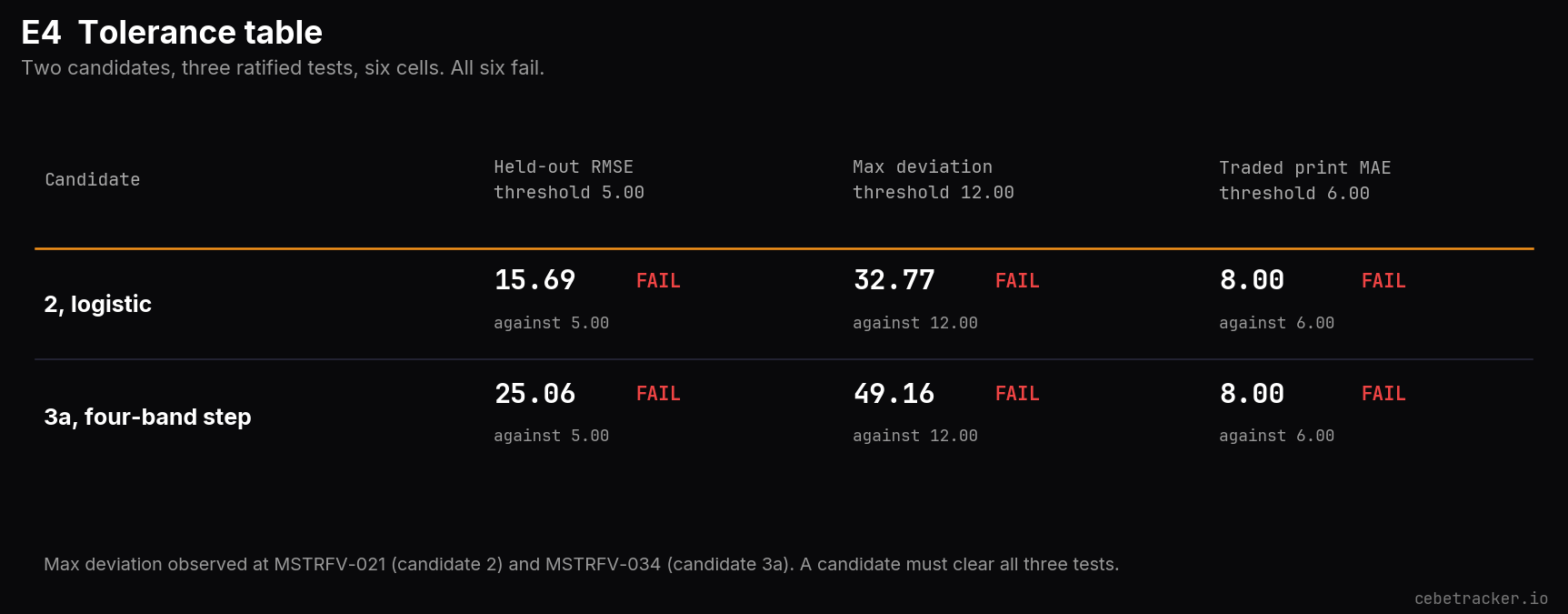
Held-out error, points of fair value to face. Rotation rows quarantined, traded print held out.
| Candidate | Free params | Held-out RMSE | Against 5.0 | Max deviation | Against 12.0 | Traded print | Against 6.0 | Verdict |
|---|---|---|---|---|---|---|---|---|
| 2, logistic | 2 | 15.69 | FAIL | 32.77 at MSTRFV-021 | FAIL | 8.00 | FAIL | FAIL |
| 3a, four-band step | 0 | 25.06 | FAIL | 49.16 at MSTRFV-034 | FAIL | 8.00 | FAIL | FAIL |
Six cells, six failures. The nearest approach to any threshold is the traded print at 8.00 points against 6.00.
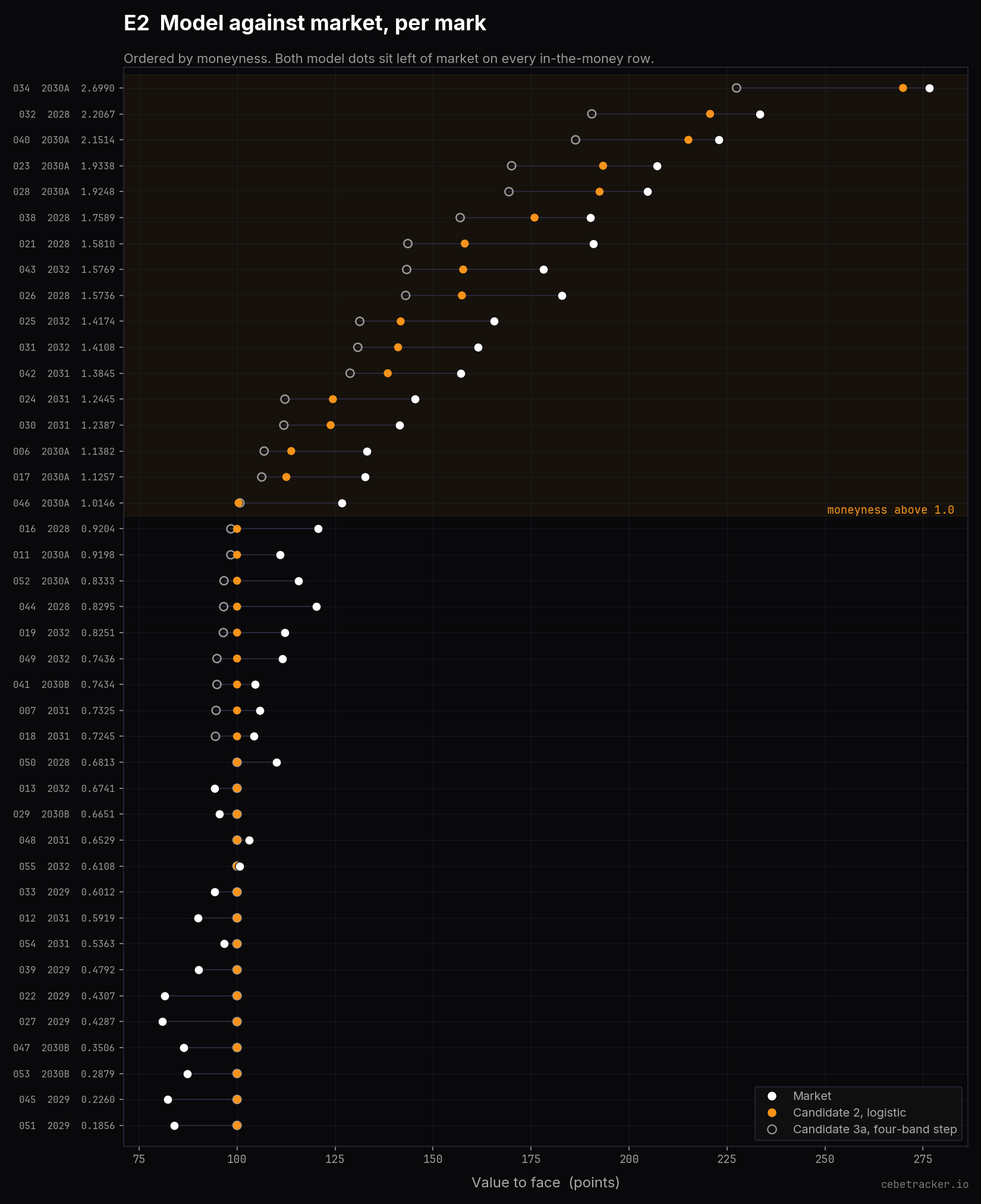
Model value sits below the observed mark on 29 of 41 marks for both candidates. Mean signed error is minus 7.22 points for the logistic and minus 14.83 points for the published schedule.
3.2 Per instrument, model versus market
Points of face. Market is the disclosed Level 2 fair value divided by principal. Miss is model less market, so a negative number means the model prices below the filing.
| Obs | Series | Date | Moneyness | Market | Cand 2 model | Cand 2 miss | Cand 3a model | Cand 3a miss |
|---|---|---|---|---|---|---|---|---|
| MSTRFV-006 | 2030A | 2024-03-31 | 1.1382 | 133.09 | 113.82 | -19.27 | 106.91 | -26.18 |
| MSTRFV-007 | 2031 | 2024-03-31 | 0.7325 | 105.75 | 100.00 | -5.75 | 94.65 | -11.10 |
| MSTRFV-011 | 2030A | 2024-06-30 | 0.9198 | 110.96 | 100.00 | -10.96 | 98.40 | -12.56 |
| MSTRFV-012 | 2031 | 2024-06-30 | 0.5919 | 90.02 | 100.00 | +9.98 | 100.00 | +9.98 |
| MSTRFV-013 | 2032 | 2024-06-30 | 0.6741 | 94.25 | 100.00 | +5.75 | 100.00 | +5.75 |
| MSTRFV-016 | 2028 | 2024-09-30 | 0.9204 | 120.72 | 100.00 | -20.72 | 98.41 | -22.31 |
| MSTRFV-017 | 2030A | 2024-09-30 | 1.1257 | 132.59 | 112.57 | -20.02 | 106.29 | -26.30 |
| MSTRFV-018 | 2031 | 2024-09-30 | 0.7245 | 104.32 | 100.00 | -4.32 | 94.49 | -9.83 |
| MSTRFV-019 | 2032 | 2024-09-30 | 0.8251 | 112.19 | 100.00 | -12.19 | 96.50 | -15.69 |
| MSTRFV-021 | 2028 | 2024-12-31 | 1.5810 | 190.87 | 158.10 | -32.77 | 143.58 | -47.30 |
| MSTRFV-022 | 2029 | 2024-12-31 | 0.4307 | 81.59 | 100.00 | +18.41 | 100.00 | +18.41 |
| MSTRFV-023 | 2030A | 2024-12-31 | 1.9338 | 207.17 | 193.38 | -13.79 | 170.04 | -37.13 |
| MSTRFV-024 | 2031 | 2024-12-31 | 1.2445 | 145.35 | 124.45 | -20.90 | 112.22 | -33.13 |
| MSTRFV-025 | 2032 | 2024-12-31 | 1.4174 | 165.58 | 141.74 | -23.84 | 131.30 | -34.28 |
| MSTRFV-026 | 2028 | 2025-03-31 | 1.5736 | 182.87 | 157.36 | -25.51 | 143.02 | -39.85 |
| MSTRFV-027 | 2029 | 2025-03-31 | 0.4287 | 80.87 | 100.00 | +19.13 | 100.00 | +19.13 |
| MSTRFV-028 | 2030A | 2025-03-31 | 1.9248 | 204.69 | 192.48 | -12.21 | 169.36 | -35.33 |
| MSTRFV-029 | 2030B | 2025-03-31 | 0.6651 | 95.46 | 100.00 | +4.54 | 100.00 | +4.54 |
| MSTRFV-030 | 2031 | 2025-03-31 | 1.2387 | 141.50 | 123.87 | -17.63 | 111.93 | -29.57 |
| MSTRFV-031 | 2032 | 2025-03-31 | 1.4108 | 161.52 | 141.08 | -20.44 | 130.81 | -30.71 |
| MSTRFV-032 | 2028 | 2025-06-30 | 2.2067 | 233.31 | 220.67 | -12.64 | 190.50 | -42.81 |
| MSTRFV-033 | 2029 | 2025-06-30 | 0.6012 | 94.21 | 100.00 | +5.79 | 100.00 | +5.79 |
| MSTRFV-034 | 2030A | 2025-06-30 | 2.6990 | 276.59 | 269.90 | -6.69 | 227.42 | -49.16 |
| MSTRFV-038 | 2028 | 2025-09-30 | 1.7589 | 190.12 | 175.89 | -14.23 | 156.92 | -33.20 |
| MSTRFV-039 | 2029 | 2025-09-30 | 0.4792 | 90.25 | 100.00 | +9.75 | 100.00 | +9.75 |
| MSTRFV-040 | 2030A | 2025-09-30 | 2.1514 | 222.91 | 215.14 | -7.77 | 186.36 | -36.55 |
| MSTRFV-041 | 2030B | 2025-09-30 | 0.7434 | 104.57 | 100.00 | -4.57 | 94.87 | -9.70 |
| MSTRFV-042 | 2031 | 2025-09-30 | 1.3845 | 157.11 | 138.45 | -18.66 | 128.84 | -28.27 |
| MSTRFV-043 | 2032 | 2025-09-30 | 1.5769 | 178.15 | 157.69 | -20.46 | 143.27 | -34.88 |
| MSTRFV-044 | 2028 | 2025-12-31 | 0.8295 | 120.25 | 100.00 | -20.25 | 96.59 | -23.66 |
| MSTRFV-045 | 2029 | 2025-12-31 | 0.2260 | 82.29 | 100.00 | +17.71 | 100.00 | +17.71 |
| MSTRFV-046 | 2030A | 2025-12-31 | 1.0146 | 126.76 | 100.38 | -26.38 | 100.73 | -26.03 |
| MSTRFV-047 | 2030B | 2025-12-31 | 0.3506 | 86.41 | 100.00 | +13.59 | 100.00 | +13.59 |
| MSTRFV-048 | 2031 | 2025-12-31 | 0.6529 | 103.03 | 100.00 | -3.03 | 100.00 | -3.03 |
| MSTRFV-049 | 2032 | 2025-12-31 | 0.7436 | 111.57 | 100.00 | -11.57 | 94.87 | -16.70 |
| MSTRFV-050 | 2028 | 2026-03-31 | 0.6813 | 110.09 | 100.00 | -10.09 | 100.00 | -10.09 |
| MSTRFV-051 | 2029 | 2026-03-31 | 0.1856 | 83.90 | 100.00 | +16.10 | 100.00 | +16.10 |
| MSTRFV-052 | 2030A | 2026-03-31 | 0.8333 | 115.71 | 100.00 | -15.71 | 96.67 | -19.04 |
| MSTRFV-053 | 2030B | 2026-03-31 | 0.2879 | 87.30 | 100.00 | +12.70 | 100.00 | +12.70 |
| MSTRFV-054 | 2031 | 2026-03-31 | 0.5363 | 96.63 | 100.00 | +3.37 | 100.00 | +3.37 |
| MSTRFV-055 | 2032 | 2026-03-31 | 0.6108 | 100.58 | 100.00 | -0.58 | 100.00 | -0.58 |
Every row traces to the accession listed for its date in section 2.2.
3.3 Where the misses concentrate
Per-series mean miss, points of face.
| Series | n | Candidate 2 mean | Candidate 3a mean |
|---|---|---|---|
| 2028 | 7 | -19.46 | -31.32 |
| 2029 | 6 | +14.48 | +14.48 |
| 2030A | 9 | -14.76 | -29.81 |
| 2030B | 4 | +6.57 | +5.28 |
| 2031 | 8 | -7.12 | -12.70 |
| 2032 | 7 | -11.90 | -18.15 |
The sign split follows moneyness, not series quality. The 2029 and 2030B are the two deeply out of the money zero-coupon series and are the only ones with positive mean miss: the model prices them at or near par while the market discounts them below par. Every series that spent time in the money carries a large negative mean.
For in-the-money marks the miss is not merely correlated with the conversion premium. Wherever the fitted weight of candidate 2 has saturated at parity, that is wherever w equals 1, the miss equals minus the premium exactly, to within 1e-9 points. That holds at 16 of the 17 in-the-money marks.
The seventeenth is MSTRFV-046, the 2030A at 2025-12-31, moneyness 1.0146, and it is worth stating rather than rounding away. Its held-out prediction comes from the single fold of nine whose steepness parameter did not pin at the optimiser's upper bound: withholding 2025-12-31 gives k equal to 123.18 and a centre of 1.02317, against k pinned at 200 and a centre near 0.972 in the other eight. At that centre the mark sits below the logistic's midpoint, so its weight is 0.2581 rather than 1, the model returns 100.38 against a parity of 101.46, and the miss of minus 26.38 exceeds the premium of 25.30 by 1.08 points.
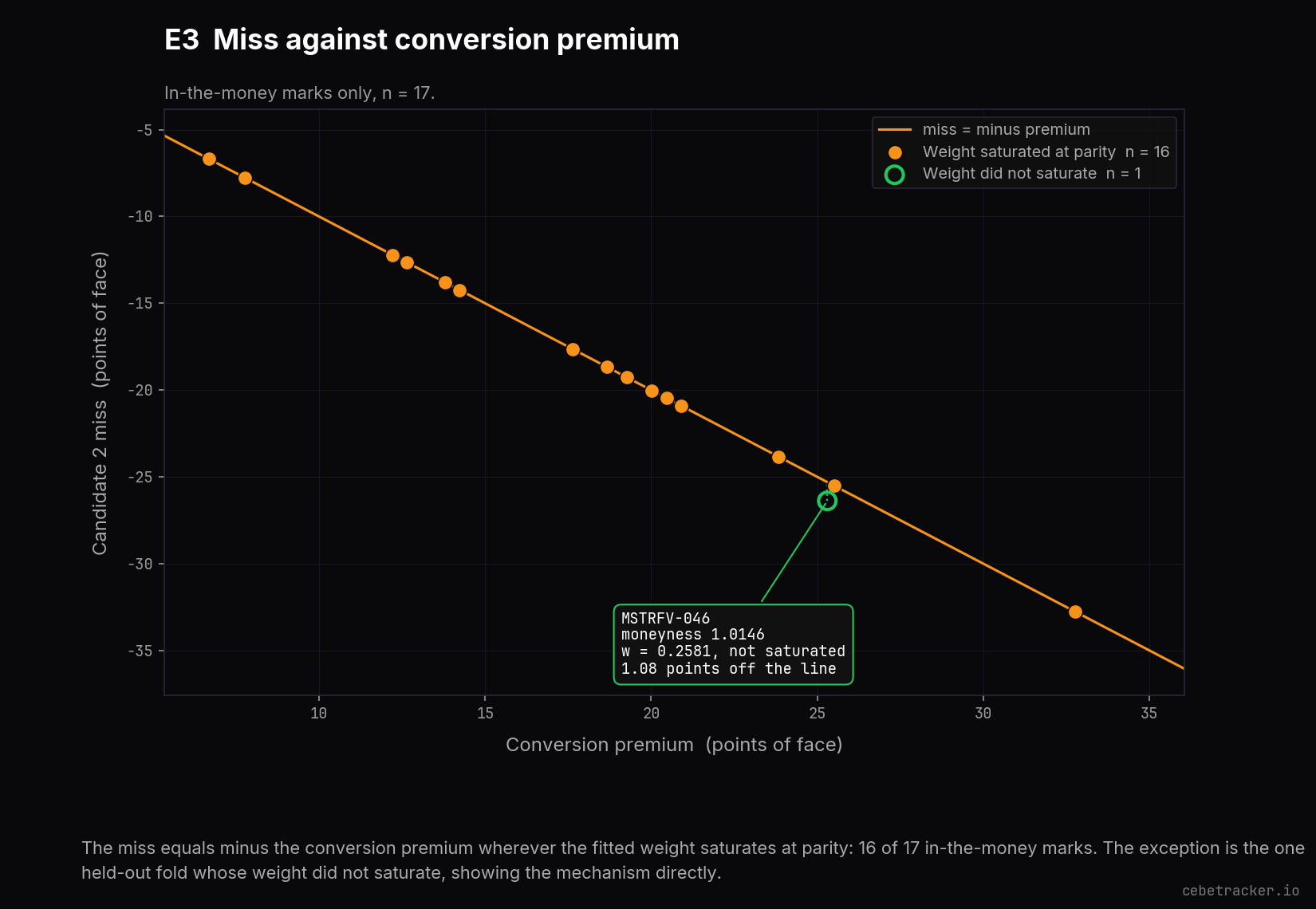
The exception is the saturation mechanism made visible. The identity is not a coincidence of the data; it is what happens when the fitted weight goes to its endpoint, and the one mark where the fit did not saturate is the one mark where the identity does not hold. That is the same phenomenon section 3.4 reports as the binary degeneracy, seen from the residual side.
The identity is a property of candidate 2 alone. Candidate 3a's conversion weight is capped at 0.75 by the published schedule, so it never saturates at parity and never satisfies the identity at any mark. The pricing error and the option time value are the same number.
3.4 Why the four pending candidates cannot change the outcome
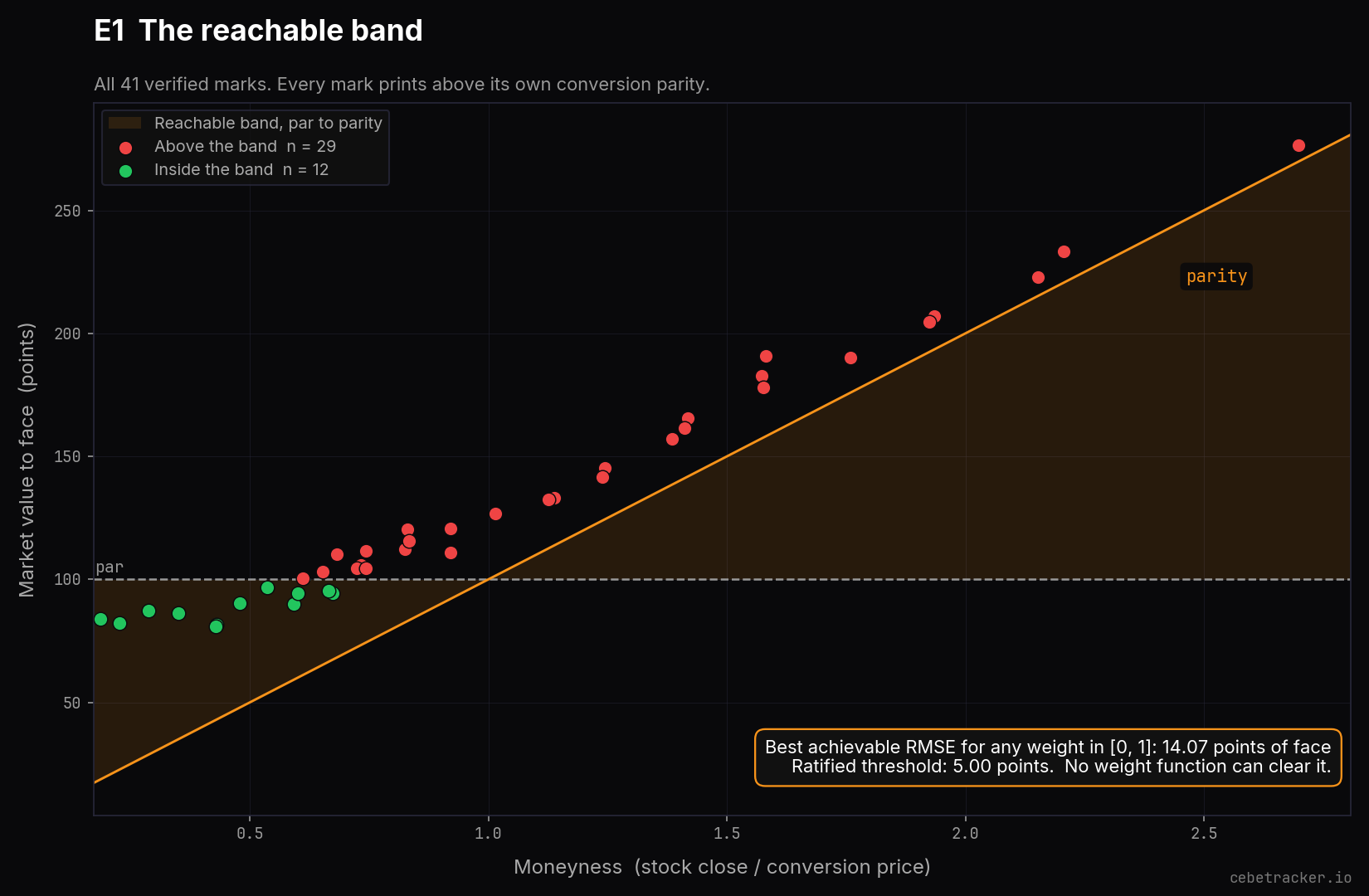
Model value to face is linear in w, so the complete set of values any weight function in [0, 1] can produce is the interval between its endpoints: par at w equals 0, and parity at w equals 1.
29 of the 41 marks lie outside that interval. All 29 lie above it. None lie below. Every in-scope verified mark prints above its own conversion parity, by 6.69 to 65.34 points of face, median 29.68.
The lowest RMSE any function in [0, 1] can achieve on this panel is therefore 14.07 points. That figure is the error of a hypothetical weight function permitted a different unconstrained w for every single mark with full knowledge of the answer. It binds all seven candidates equally and exceeds the ratified 5 point threshold by a factor of nearly three.
No candidate can pass under this price map, with or without the volatility series. The volatility series affects relative ranking and Calibration 2 groundwork. It does not affect the gate outcome.
This figure was computed and disclosed before the tolerance was transmitted. It is candidate-invariant, so it cannot advantage or disadvantage any candidate and cannot be used to select a tolerance that favours one.
Continuous weighting collapsed to the binary case it was written to succeed. When the target sits above both endpoints of a linear function, the error-minimising choice is always an endpoint and never an interior point. The best available weight under this construction is therefore w equals 1 above parity and w equals 0 below it, which is the binary toggle, at RMSE 15.64 points. The fitted logistic reached the same place empirically: its steepness parameter pinned at the optimiser's upper bound of 200.0 in 8 of the 9 folds and in the full-sample fit as well, at centres from 0.96937 to 0.97222. The fit's answer to "what shape of continuous curve fits best" was a step at parity.
The ninth fold, which withholds 2025-12-31, is the exception and it publishes rather than being smoothed over: k equal to 123.18 at a centre of 1.02317. Even unpinned it is steep, a transition spanning roughly four percentage points of moneyness, which is a step in all but name. It is also the fold that produces the one in-the-money mark where the premium identity of section 3.3 does not hold. One fold in nine declining to pin does not soften the finding, and its single visible consequence is a 1.08 point departure at one near-the-money mark.
Specification section 3.1 names continuous weighting as the canonical method and the binary case as the ratified v1 implementation it is meant to succeed. Under this price map, that succession has nothing to offer. This is a finding about the price map, not about continuous weighting. A construction carrying time value would have interior optima and the candidates would separate.
3.5 Sensitivities
Rotation dual run. Rows are as filed throughout.
| Candidate | Quarantined, primary | As filed, rotation rows included |
|---|---|---|
| 2, logistic | 15.69 | 25.74 |
| 3a, four-band | 25.06 | 34.86 |
Both fail under either treatment. Disposition unchanged.
Volatility cap. The 65 percent cap is inactive at every volatility at or below 65 percent, so candidate 4a is numerically identical to candidate 1 across that entire region and the cap engages only where both are already far outside tolerance. The cap is difficult to test on this panel whatever the sourced series shows. The cap's attribution to a named practitioner, dated 2026-07-28, is unverified and carries no citable source. It does not enter any published method as a named convention on that basis.
3.6 Two published surfaces carry different equations
The Claims Grade page of 2026-06-14 states Adjusted Senior Claims = sum of (face x weight) minus cash, which gives model value to face of 1 - w. Specification v1 section 3.1, ratified 2026-07-26, gives 1 + w(m - 1). They agree only where moneyness is zero.
This is not a discrepancy resolved by picking one. The page's schedule is a standing-weight claims-line object: it states what fraction of face still stands ahead of common. The specification's formula is an instrument-value object: it states what the claim is worth. Same weights, different objects, and only the second can price a convertible. The claims-line reading was therefore documented rather than fitted. Both surfaces should name which object they carry.
3.7 Out-of-sample, the traded print
The May 2026 negotiated repurchase of approximately 1.50B of 2029 principal for an estimated aggregate cash price of approximately 1.38B, roughly 92.0 percent of par, settled on or about 2026-05-19. Accession 0001193125-26-225361. Held out of fitting entirely.
Both candidates model 100.00 against a market of 92.00. Both miss by 8.00 points against a 6 point threshold.
Three limits, flagged EST because the sourcing is thin:
- n equals 1. It supports no distributional claim.
- Both legs are stated as approximate in the 8-K. Exact figures are due with the Q2 2026 10-Q and this row is refreshed then.
- Parity was 24.5 percent. It constrains only the deep out of the money tail and says nothing about behaviour at or above the conversion price, which is where the candidates most disagree.
This print is one of the 12 marks the construction can reach at all. Both candidates still miss it.
3.8 Comparison against the published schedule, reported only
The absolute tolerance is the launch gate. This comparison binds nothing.
| Candidate | Held-out RMSE | Improvement |
|---|---|---|
| 3a, published four-band schedule | 25.06 | baseline |
| 2, logistic | 15.69 | 37.4 percent |
The logistic clears the 10 percent labelling threshold and is labelled as outperforming the published schedule. No replacement follows. Schedule succession is a specification ratification decision informed by Calibration 2.
Bias label, applying to this and every ranking under this price map. Because the miss is one signed, a candidate improves its score by overstating conversion weight, which absorbs the time value the construction cannot carry. This ranking measures time-value absorption as much as weight accuracy. The logistic's margin is substantially a margin at absorbing premium.
The published schedule's largest single miss is MSTRFV-034, the 2030A at 2025-06-30 with moneyness 2.6990. The schedule's conversion weight is capped at 0.75 by construction, so a convertible at 2.7 times its conversion price is still carried as one quarter senior, and the deviation reaches 49.16 points.
4. The decision
No candidate met the tolerance. The no-pass clause fired.
The gate holds. The continuous conversion weight of specification section 3.1 is not launched. No computed conversion-weighted figure appears on any tracker surface.
The marks-based Adjusted Claims layer already live at cebetracker.io/claims/, which carries observed market prices for quoted claims and holds convertibles at standing value with the binary symmetry_shares rule, is not gated by section 8 and is unaffected. Canonical CEBE is unchanged by anything in this document. Senior Claims % is unchanged. No published figure moves.
The result is not that the candidates were poorly chosen. The construction under test carries no time value and every observed mark does, so the gap between them was bounded below at 14.07 points before any candidate ran.
Four items route to a specification v1.2 discussion:
- The section 3.1 blend cannot reach 29 of 41 observed marks. Either the formula gains a term for time value, or the layer states plainly that it values claims at a blend of par and parity and is not attempting to reproduce market prices.
- Under this price map, continuous weighting cannot outperform the binary case that section 3.1 phasing and section 7 framing both assume it will succeed.
- The two-object finding of section 3.6.
- The direction of the error. Model value below market value understates the senior claim and raises MABE, so the construction errs toward flattering the common.
The rulebook for the second attempt publishes ahead of its results at Calibration 2: Pre-Registration. The pass thresholds are unchanged from this study.
5. What Calibration 2 changes
The tolerance does not change. RMSE ≤ 5 points, maximum single-observation deviation ≤ 12 points, MAE ≤ 6 points on the repurchase transaction prints, all three clearing on held-out error. The same three numbers, unchanged, carried forward. Only the method and the inputs change.
Calibration 2 is expected to carry more than one traded print, since the Q2 2026 10-Q states exact figures for the May 2026 repurchase and any further retirements settle inside the next window. At more than one observation the third test becomes a mean rather than a single absolute error, which is what the tolerance was written for.
Method adjustments
- Price map. Calibration 2 tests the bond floor plus conversion option decomposition, which carries time value and therefore has a reachable set that includes the observed marks. Model value to face becomes the discounted bond floor plus the conversion option value per unit face. Every candidate weight function is evaluated inside that construction rather than inside the par to parity blend.
- Conditioning inputs published with the result. The decomposition requires a credit spread and a volatility, and one observed price per mark cannot identify both. Whichever is pinned externally is published alongside the result, with its source, or the result is not auditable.
- Effective maturity. The bond floor runs to the investor put date rather than stated maturity. All six series carry a holder put 18 to 30 months before maturity.
- Issuer call. Five of six series pass an earliest call date inside the observation window. The soft call's effect on the option leg is modelled or its omission is stated as a directional bias.
Input adjustments
- Implied volatility series at the ten measurement dates. Dashboard prints where they exist, option-chain implied volatility interpolated to each convertible's remaining term where they do not, method documented and sources named per date. Volatility is not fitted and no flat value is assumed. Partial coverage is disclosed as partial. Candidates 1, 1b, 4a and 4b join the panel when this lands.
- Risk-free curve at the ten measurement dates.
- Total BTC held and total gross claims at the ten measurement dates, so the tolerance's effect can be stated in Adjusted Claims percentage points as context. The binding tolerance stays in points of face. For scale, the six in-scope series carried 8.214B USD of face at 2026-03-31.
- Conversion prices for the 2025 and 2027 notes, traced to their indentures, adding 8 observations at the left edge of the window.
- Refreshed traded print when the Q2 2026 10-Q states exact principal and cash price, replacing the EST flag.
- Filing-level re-verification of the three 2025-06-30 rotation-suspect rows by the data lane.
- The disclosed convertible aggregate as its own sourced column, carrying the figure, the row label it came from and its accession, at each measurement date. Calibration 1 could not re-run the aggregate reconciliation downstream because the aggregate exists only as an assertion in the companion source log. Carrying it as data makes the gate reproducible by any reader.
The credit control already in hand, the 6.125 percent Senior Secured Notes due 2028 printing 96.62 to 97.01 percent of par across three marks from 2023-12-31 to 2024-06-30, bounds an unsecured spread from below rather than measuring it, since those notes are secured and the convertibles are not.
6. Reproduction
The scoring harness, its test suite and the run logs ship with this study. 21 tests pass, all on synthetic data. The gate block is mechanical: the harness raises an error unless a complete ruling exists on disk naming all sixteen required fields, and two tests assert that an absent or incomplete ruling does not satisfy it. The panel in section 3.1 ran only after the tolerance file was written.
Source data: mstr_convert_fair_value_marks_2026-07-27.tsv with its companion source log, built 2026-07-27 by direct EDGAR extraction.
Limitation, 2026-09-07. Neither the source data nor the companion record carries a published hash on this page, so a reader has no attestation against which to check that the files they obtain are the files this study scored.
The four exhibits on this page are rendered by build_calibration1.py, which ships beside this page as the exhibit source of record. It reads the per-mark exhibit CSV and reproduces the 41 rows, the 29 by 12 by 0 band split, the 17 in-the-money marks, the 14.07 floor and the six tolerance cells as verification gates before it renders anything.
Note, 2026-09-05: every reported k carries the optimiser bound
The logistic's fitted steepness parameter reached the optimiser's upper bound of 200.0 in eight of the nine leave-one-date-out folds and in the full-sample fit. A parameter sitting on its bound is not an estimate of that parameter. It is the optimiser saying the objective still improves in that direction when it runs out of room, so the value reported is a property of the bound as much as of the data, and a different bound would have produced a different number with the same meaning.
The standard, registered here. Any k reported for this candidate, on this page or anywhere downstream of it, carries that qualification with it. A reported k of 200.0 is read as "at the bound", never as a fitted steepness. The one fold that did not pin, which withholds 2025-12-31 and gives k equal to 123.18, is the only k on this page that is an estimate in the ordinary sense, and section 3.3 already publishes it as the exception rather than smoothing it away.
What this does not change. No scored figure and no disposition. The finding it sharpens is the one already stated: the fit's answer to what shape of continuous curve fits best was a step at parity, and a steepness pinned at its bound is how that answer shows up in the parameters.
Companion record
The pre-registration ruling log, carrying all thirteen rulings as ratified on 2026-07-28, the two mis-stamped rulings with their corrections, and the floor disclosure, publishes at Calibration 1 ruling log. The gate this study answers is Specification v1 section 8.