I. Coffeezilla saw the motion, missed the machine
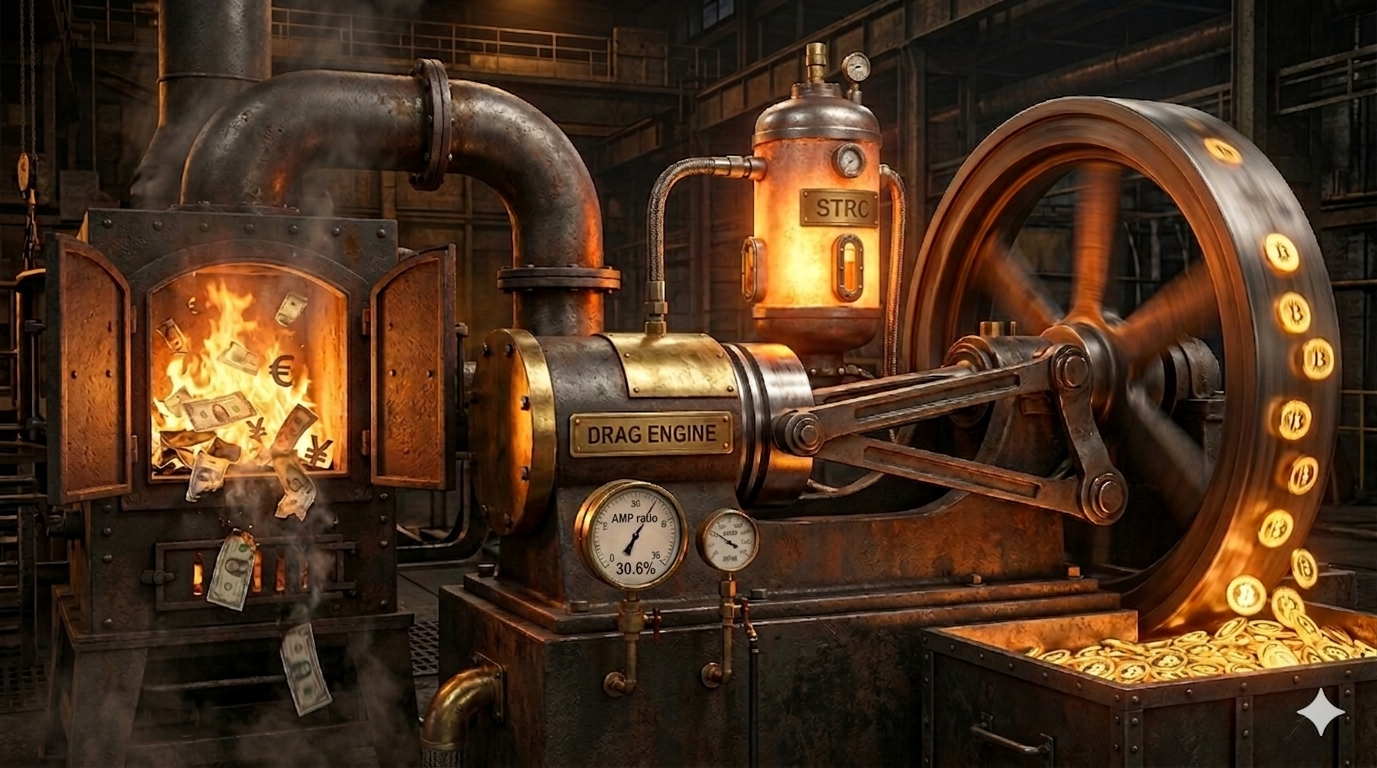
The flywheel in Bitcoin treasury is the most popular analogy to describe the accumulation mechanic. Coffeezilla calls it a perpetual motion machine. Perpetual motion is what we call mechanisms we can't explain. Magic is what we call mechanisms we can't see. This is neither. The Bitcoin standard is the Rosetta Stone. Place the capital structure on it and the engine becomes legible, mechanical, and designed. Saylor hitched his sail to the apex asset on earth and built a machine to capture the spread between Bitcoin and the endless debasement of every alternative asset class. The machine is Strategy. The engine is the Claims Engine. The fuel is fiat's decay against scarcity.
The flywheel observation is already common. Strategy raises, buys Bitcoin, Bitcoin appreciates, Strategy raises more. Analysts describe the motion. Critics dismiss it as self-reference or worse. Neither camp has named what drives the wheel. The wheel is the output. The engine is the system that produces the output.
II. The fuel: fiat decay against scarcity
The engine's fuel is the oldest trade in finance dressed in new clothes: short a debasing currency, long a scarce asset. What's new is that the scarce asset is mathematically capped at 21 million units, and the debasing currency isn't one currency but every fiat regime on earth issuing against its own productive base to service obligations that compound faster than productivity can keep up.
The fuel isn't Bitcoin appreciation. Appreciation is one mode of fuel extraction, not the fuel itself. The fuel is the structural spread between fixed scarcity and unbounded fiat issuance. That spread exists in every regime. It produces Bitcoin appreciation over time, and what is developing in real time is a demand for Bitcoin-backed yield during the windows when appreciation pauses.
Strategy's preferred stack denominates claims in dollars and euros. Metaplanet's in yen. The claims are fixed in fiat. The asset backing them is fixed in supply. When Bitcoin appreciates, those claims shrink in Bitcoin terms without any action from the issuer. A $10B claim at $100K BTC represents 100,000 BTC of senior claim. The same $10B claim at $150K BTC represents 66,667 BTC. Same instrument, same face value, one third less of the stack claimed. When Bitcoin falls, appreciation mode slows, but the structural spread is still there. That's when the second extraction mode activates.
Capital that wants yield backed by hard collateral rotates into the instrument. STRC is not Bitcoin exposure. It is fixed income overcollateralized by Bitcoin, offering better yield than treasuries and more transparent backing than private debt. It pulls fixed income capital into the Bitcoin network without offering those holders any BTC upside. Different extraction mode, same underlying fuel.
That compression isn't coincidence. That rotation isn't coincidence. They are what fiat-denominated claims and Bitcoin-backed yield do when held against a sustained debasement regime. The spread is the fuel, and the fuel isn't running out.
III. The engine: piston, flywheel, operator
Here's how the engine converts fuel into motion.
Bitcoin appreciates. Fiat claims compress in Bitcoin terms. Senior Claims % falls below its anchored level. Headroom opens in the capital structure. Strategy fills the headroom with new preferred issuance. Proceeds convert to Bitcoin. The stack grows. Senior Claims % returns to its prior ratio, but the base underneath has expanded.
That is one piston stroke of the preferred equity.
The flywheel turns on the energy created by the constant motion of the piston. The piston is powered by the currency burn rates of governments around the world. Senior Claims % compression is a single stroke. The Claims Engine is the piston and flywheel together, running continuously, putting more Bitcoin behind the common equity at the same structural Senior Claims % level.
Strategy is the operator. Pistons don't fire themselves. Someone decides when to issue, how much, at what rate, into what demand. Saylor and the team built the instruments, sized the tranches, tuned the dividend rates, and sequenced the issuances across years. The engine is a designed object. It did not assemble itself.
IV. The engine runs in every regime
The critique that sinks most BTCTC flywheel narratives: what happens when Bitcoin doesn't appreciate?
The Claims Engine doesn't need continuous Bitcoin appreciation. It needs the scarcity-decay spread over meaningful time horizons. Those are different things. Price direction is short-term noise. The spread is structural.
In a Bitcoin bull run, the engine runs on appreciation feedback. Fiat claims compress in Bitcoin terms. Pistons fire on every cycle. The flywheel accelerates. This is the mode critics and enthusiasts both point at, which is why it dominates the discourse. It is also the most obvious and the least interesting.
In a Bitcoin bear market, the engine runs on capital rotating into Bitcoin-backed yield. STRC pays 11.5% backed by Strategy's Bitcoin reserve and structurally senior to common equity. It debuted as the largest IPO of 2025. Between Bitcoin's October 6, 2025 all-time high of $126,198 and its March 2026 local low near $60,000, a 52% drawdown over five consecutive red months, STRC face grew from $3 billion to over $8.5 billion. Strategy almost tripled the instrument during the worst Bitcoin drawdown since 2022. In the final two weeks of the decline, Strategy fed $3 billion in fiat claims into the furnace to produce Bitcoin that will never see another wallet again.
The pistons did not stop firing when Bitcoin fell. They fired harder. The engine found a different fuel input and kept running.
Two regimes observed. One engine, engineered to run regardless of Bitcoin price direction. It runs on the structural spread between Bitcoin's fixed supply and every fiat regime's ongoing expansion against it.
V. Terminal state: the engine keeps running after the feedback loop breaks
There's a point where this stops being a story about Strategy and Bitcoin's price in the same sentence.
Strategy does not move Bitcoin's price by design. Their execution is TWAP-weighted, spread across trading sessions, built to minimize market impact. Critics point to their entry prices as evidence. Strategy consistently pays market or above, not below. Some analysts argue that sustained accumulation of 815,000 BTC must have supported Bitcoin's floor during drawdowns, and they may be right. But there is no concrete evidence of direct price causation, and Strategy has never claimed it.
The feedback loop that critics call self-referential (raise, buy, price goes up, raise more) assumes a price impact that isn't demonstrated. What IS demonstrated is that the capital structure captures the spread between Bitcoin and fiat regardless of who or what is driving Bitcoin's price. Sovereign accumulation, institutional rotation, macro flows, retail. The engine doesn't care which source drives appreciation. It captures the compression on any of them.
The Claims Engine keeps running. Bitcoin appreciation from any source, any source at all, compresses Strategy's fiat-denominated claims. Yield-seeking capital from any stress event rotates into the preferred stack. Pistons fire on whichever input is active, the flywheel turns, and the stack grows.
This is the structural proof the engine is real. It doesn't need Strategy to be the marginal buyer. It needs Bitcoin to exist on a different monetary standard than the claims denominated against it. That condition is not expiring.
At scale, the USD framing becomes noise. Strategy is already there. They report BTC Yield, not dollar returns. They measure sats per share, not earnings per share. A $3 billion STRC quarter sounds enormous in dollar terms. Measured against Bitcoin's circulating supply it is a rounding error. Measured in sats added per common share it is precise. The dollar figure is the one losing information, not the Bitcoin figure. Strategy stopped measuring in the unit that decays and started measuring in the unit the engine produces. The capital markets haven't caught up yet.
VI. Coffeezilla saw the flywheel. He missed the engine.
Coffeezilla called it a perpetual motion machine. Perpetual motion machines don't exist in closed systems. Energy always leaks. Friction stops the wheel. That critique would land if the system were closed.
The Claims Engine isn't closed. It's attached to a pressure differential that isn't going away. Fiat supply is unbounded. Bitcoin supply is capped at 21 million. That spread is the fuel. The pistons are the stroke. The flywheel is the output driven by the engine of Strategy's design.
Saylor didn't invent the spread. He engineered the mechanism to capture it. And he did it inside the system that created the spread, using the system's own instruments, in plain sight and screaming follow me the whole time. The bravest followed. Alexandre Laizet of Capital B said recently: "Intelligence is relatively abundant. Courage is not."
What the uninitiated call magic is just courage plus engineering. Arthur C. Clarke wrote that any sufficiently advanced technology is indistinguishable from magic. The Claims Engine isn't magic. It's technology read in the wrong language. On the fiat standard, the capital structure looks like leverage and dilution and risk. On the Bitcoin standard, it resolves into pistons, flywheel, and fuel. Bitcoiners see the engine because we measure in the unit the engine produces.
Coffeezilla sees the flywheel spinning. He points and claims trickery because flywheels don't spin themselves. The engine was designed in public, fueled by the currency he's using to dismiss it. Get on the Bitcoin Standard and see for yourself.